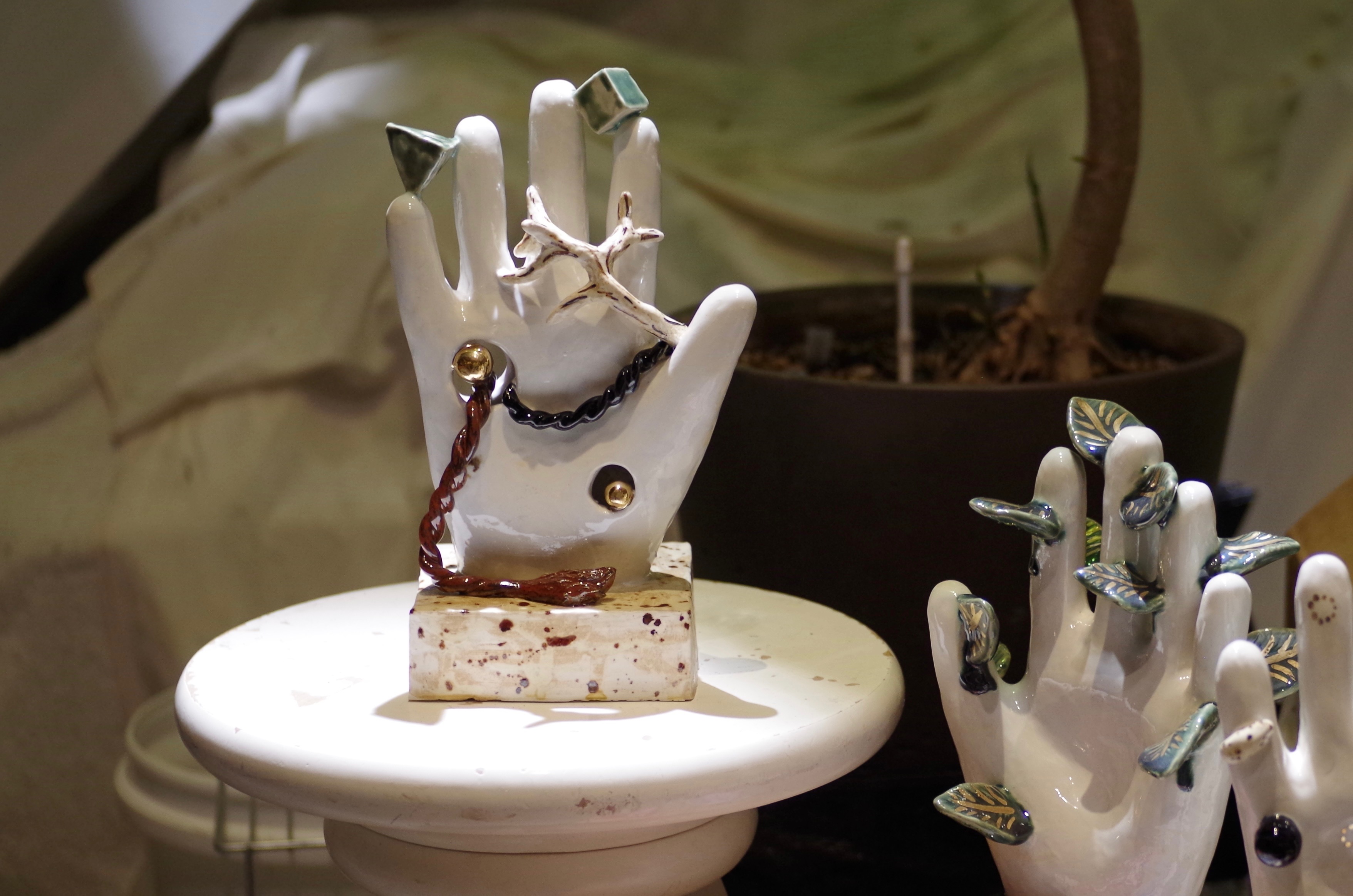
Fig is pleased to present En Passant, a solo exhibition by Shizuka Okada. Marking her third solo exhibition at Fig, the show features nine new ceramic works alongside a selection of works on paper.
As discussed in previous exhibitions at Fig, the notion of drawing runs throughout Okada’s practice. If we understand drawing not simply as a physical medium or a preparatory sketch, but rather as a form of thinking or an act, it implies an approach to defining, constructing, and shaping things gradually and intermittently in the course of making. Much like drawing a line or jotting down a note on a sheet of paper, Okada’s works emerge through the accumulation of countless everyday elements, which come together in various combinations at any given moment.
Titled En Passant, the exhibition brings together works that Okada began making around this spring. Around that time, she had started playing games such as Shogi and chess with her family. Taking this as a point of departure, her thoughts unfold like a chain reaction, overlapping and intertwining in multiple layers.
What is important to emphasize here is that these thought processes do not take place solely in the mind; they are also part of a physical process, one in which Okada engages with clay through the movement of her hands. The works eventually undergo firing, becoming ceramic objects and assuming a more enduring form. This permanence seems to stand in contrast to the fleeting and immaterial nature of thought. Yet, while ceramics possess a certain durability and solidity, the inherent fragility of the material suggests that the thoughts embodied in them belong only to the particular moment in which they arise. When it breaks, it breaks.